




For investors in the stock market, the first few months of 2026 have been something of a rollercoaster.
The FTSE 100 - an index of 100 of the largest companies listed on the London Stock Exchange – passed the 10,000-point mark for the first time early in the new year, before peaking at a record high of 10,910 on 27 February.
However, following the outbreak of war in the Middle East, global markets have been volatile. In the UK, the FTSE 100 yo-yoed throughout March and into April, dipping below 10,000 at the end of March.
Amid daunting headlines and widespread reports of stock market falls while energy prices soar, it can be easy to feel overwhelmed. But often, volatility is no reason to panic. In fact, it’s part and parcel of investing.
By staying calm and acting strategically, rather than impulsively, you could help improve your investment returns. Read on to discover why stock market volatility is no reason to panic and the importance of staying calm during a downswing.
Volatility is part and parcel of the stock market
While you might often hear about market volatility in reference to a particular downswing, volatility isn’t so much an event as it is an inherent characteristic of the stock market.
The value of stocks and shares (also known as “equities”) fluctuates constantly. Minute by minute, prices rise and fall as a result of various market forces, such as:
· The global economy
· The geopolitical climate
· Commodity prices
· Currency fluctuations
· Company and sector performance
· Regulatory changes
· Interest rates
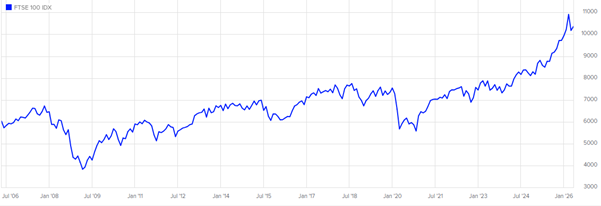
Of course, some downswings will be more significant than others. But even substantial falls in the FTSE 100 are common. As shown in the graph below, values have taken a significant downturn several times over the past 20 years.
As such, it’s often wise to accept volatility as an inevitability of investing in the stock market. That way, you can brace yourself for sudden drops and prepare to weather any stock market storms.
Markets typically bounce back from even significant downswings
After each and every downswing to date, the FTSE 100 has eventually recovered and gone on to reach new record highs.
As demonstrated in the graph above, over the long term, the index has trended upwards despite multiple drops along the way.
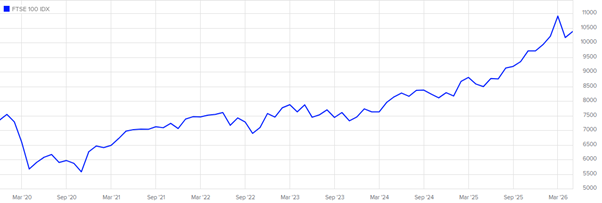
One of the most significant downswings in recent history was in 2020, when the outbreak of the Covid-19 pandemic saw values drop from 7,542 to 5,671 (24.8%) in just three months. However, as shown below, values had recovered to pre-pandemic levels by April 2022 and gained a further 2,386 points by the start of 2026.
Investors who stayed invested throughout a downswing have historically seen values recover and continue growing over time. As such, provided you stay the course and remain invested for the long term, your investments could recover from the current volatility and potentially even exceed their previous highs.
Of course, historical trends are not a guarantee of future performance, and the timescales for recovery can vary significantly. In some cases, the markets can take several years to bounce back; in others, recovery can take just a matter of weeks. But by staying invested, you could increase your chances of values recovering and growing in the months and years ahead.
You may only make a real loss if you sell
Since markets typically recover over time, you’re generally only at risk of making a loss if you sell during a downswing.
When values start to fall, your instinct may be to exit the market to “cut your losses” before the markets drop any further. However, this approach effectively guarantees you a loss, removing any possibility of future recovery.
The recent market volatility may feel daunting. But if you’re not planning on selling soon, the current prices are unlikely to be a true reflection of the value of your investments when you do choose to sell further down the line.
To help you avoid a knee-jerk reaction when markets fall, it can be helpful to limit your exposure to stock market news. Continuously tracking values and indices when you’re not planning to sell anytime soon may serve little purpose other than feeding your anxiety and inciting impulsive decisions.
In some cases, if you’re nearing the end of your planned investment term, it may be worth staying invested to benefit from any future recovery. However, remember that recovery is not a guarantee, and future performance will heavily depend on the particular investments you hold and unpredictable market conditions.
A financial planner can help you navigate stock market volatility
It’s natural to feel overwhelmed or even panicked by significant stock market downswings. But by keeping the above points in mind, you could help ease your anxiety and avoid making impulsive decisions based on emotions.
A financial planner can also help guide you through periods of increased volatility. By keeping a close eye on the markets, Dodd Wealthcare can offer insights, guidance, and reassurance to support you in managing your investments and building wealth for the long term.
What’s more, we can also help you curate a resilient investment portfolio suited to your personal preferences, goals, and risk appetite. By supporting you to select a diverse range of investments across various asset classes, sectors, geographies, and risk profiles, we can help limit your exposure to unpredictable market conditions.
If you’re confused by the price of certain commodities rising, such as gold, while other areas of your investment portfolio are declining, we can also help you make sense of the markets and evaluate your overall portfolio’s performance.
Get in touch
Whether you’re concerned about market volatility or looking to build your portfolio’s resilience for the long term, get in touch to find out how we can help.
Email info@doddwealthcare.co.uk or call 01228 530913 / 01768 864466 to learn more about how we can help.
Please note
This article is for general information only and does not constitute advice. The information is aimed at individuals only.
All information is correct at the time of writing and is subject to change in the future.
The value of your investments (and any income from them) can go down as well as up and you may not get back the full amount you invested. Past performance is not a reliable indicator of future performance.
Investments should be considered over the longer term and should fit in with your overall attitude to risk and financial circumstances.
