



In 2026, you may be hoping to grow your wealth through saving and investing, or perhaps you’re planning to share your money with loved ones.
Whatever your plans for the year, you most likely want to minimise your tax bill when you grow or gift your wealth.
From Income Tax to Inheritance Tax (IHT), there are various tax-efficient allowances and exemptions available each year. By making the most of these allowances, you could help mitigate your tax liabilities.
In general, these allowances renew on 6 April 2026. Since many of them cannot be carried over into the new tax year, there are only a couple of months left to take advantage of your 2025/26 tax-efficient allowances.
Keep reading to learn five tax-efficient allowances you might wish to use up before April.
1. Gift without risking a future Inheritance Tax charge
Generally, you may be able to gift an unlimited amount to anyone you choose without incurring an IHT bill. However, should you die within seven years of making the gift, the value may be included in your estate for IHT purposes.
That said, each year you can make gifts up to the annual gifting exemption without running the risk of them being included in your estate when you pass away. In 2025/26, this exemption allows you to gift up to £3,000 a year and have it immediately fall outside the value of your estate. You could use the full allowance on one person or spread it across multiple recipients each year.
Provided you use your current year’s allowance first, you may be able to carry forward any unused annual exemption from the previous year. If you’re in a couple, both you and your partner will have your own allowances.
As a result, if neither of you has used your 2024/25 or 2025/26 annual exemptions so far, together you could gift up to £12,000 tax-free before 6 April 2026.
2. Save and invest tax-efficiently using your ISA allowance
As of 2025/26, you can typically pay up to £20,000 a year into an ISA without being charged tax on your fund’s growth. This allowance applies across all adult ISAs, including:
- Cash ISAs
- Stocks and Shares ISAs
- Innovative finance ISAs
- Lifetime ISAs (up to a maximum of £4,000)
These accounts provide a tax-efficient wrapper to grow your wealth without being taxed on interest or investment returns. The ISA allowance resets on 6 April each year, and you cannot carry over any unused allowance.
That said, the ISA allowance is set to change next year. From April 2027, the tax-free allowance for Cash ISAs will effectively be reduced to £12,000 a year for under-65s. You will still be able to use the full £20,000 allowance by using a Stocks and Shares ISA or a combination of multiple adult ISAs.
3. Earn interest tax-free up to your Personal Savings Allowance
For interest earned on savings held outside of an ISA, tax may be charged at your marginal rate if your annual income exceeds the Personal Allowance. As of 2025/26, the Personal Allowance is £12,570 a year.
Depending on your Income Tax bracket, you may still be able to earn interest up to your Personal Savings Allowance (PSA) without being taxed.
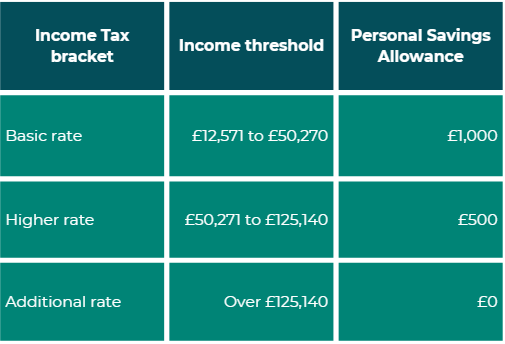
If your annual earnings are less than £17,570, you may be eligible for a starting rate for savings of up to £5,000 a year.
From April 2027, the tax rate for interest on non-ISA savings exceeding your PSA will increase by two percentage points. As such, tax will be charged at the following rates:
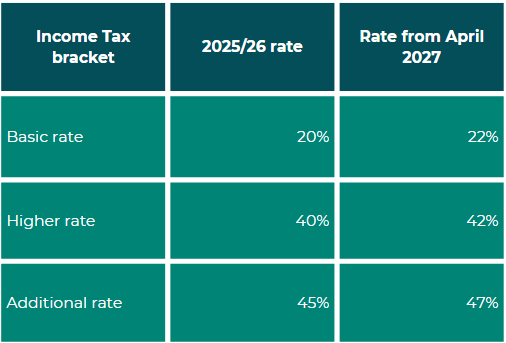
Your PSA will reset on 6 April and cannot be carried forward. Interest earned through an ISA does not typically count towards your PSA.
If you haven’t used up your PSA for this tax year, but are likely to do so in the coming years, you might consider strategically moving your funds between your accounts to make the most of the PSA.
For example, to get the maximum benefit from the tax-efficient allowance on an ongoing basis, you may consider devising a strategy that paces your savings’ maturation over a number of years.
4. Utilise your pension’s tax-efficient benefits
Generally, when you pay into your pension, you can claim tax relief at your marginal rate. As such, contributing £100 to your pot would technically “cost” you:
- £80 if you’re a basic-rate taxpayer (20% relief)
- £60 if you’re a higher-rate taxpayer (40% relief)
- £55 if you’re an additional-rate taxpayer (45% relief)
Tax relief is typically available on contributions up to your Annual Allowance. In 2025/26, this is usually £60,000 or your total annual earnings, whichever is lower.
However, if you flexibly access your pension, you may trigger the Money Purchase Annual Allowance (MPAA). This can reduce your Annual Allowance down to £10,000.
Similarly, your allowance may taper down if you earn over £200,000 a year and your adjusted net income (which includes any employer pension contributions) totals over £260,000.
Your allowance resets on 6 April, but you may be able to carry forward up to three years’ unused allowance. What’s more, if you’re a higher or additional-rate taxpayer and have not yet claimed tax relief above the basic rate, you may be able to backdate your claim by up to four years.
By making the most of your Annual Allowance each year, you could provide a significant boost to your pension with tax relief.
5. Mitigate your Capital Gains Tax bill by using your Annual Exempt Amount
When selling capital assets for a profit, you may be charged Capital Gains Tax (CGT). Taxable assets include:
- Equities
- Property (other than your primary residence)
- Possessions worth over £6,000 (other than a vehicle)
For profits made after 6 April 2025, the applicable rate of CGT will depend on your Income Tax bracket:
- Basic-rate taxpayers: 18%
- Higher and additional-rate taxpayers: 24%
That said, you can generally make gains up to the Annual Exempt Amount without paying tax. As of 2025/26, this tax-free allowance is generally £3,000, or up to £1,500 for trusts.
Again, this allowance renews on 6 April and cannot be carried forward. As such, if you’re planning on selling multiple taxable assets in 2026/27, you might consider moving some transactions forward to take advantage of this year’s Annual Exempt Amount.
Get in touch
Whether you’re looking to reduce your estate’s IHT bill through tax-efficient gifting or make the most of your pension’s Annual Allowance, email info@doddwealthcare.co.uk or call 01228 530913 / 01768 864466 to learn more about how we can help.
Please note
This article is for general information only and does not constitute advice. The information is aimed at individuals only.
All information is correct at the time of writing and is subject to change in the future.
Please do not act based on anything you might read in this article. All contents are based on our understanding of HMRC legislation, which is subject to change.
The Financial Conduct Authority does not regulate estate planning, tax planning, or trusts.
A pension is a long-term investment not normally accessible until 55 (57 from April 2028). The fund value may fluctuate and can go down, which would have an impact on the level of pension benefits available. Past performance is not a reliable indicator of future performance.
The tax implications of pension withdrawals will be based on your individual circumstances. Thresholds, percentage rates, and tax legislation may change in subsequent Finance Acts.
Workplace pensions are regulated by The Pensions Regulator.
Your pension income could also be affected by the interest rates at the time you take your benefits. The tax implications of pension withdrawals will be based on your individual circumstances, tax legislation, and regulation, which are subject to change in the future.
